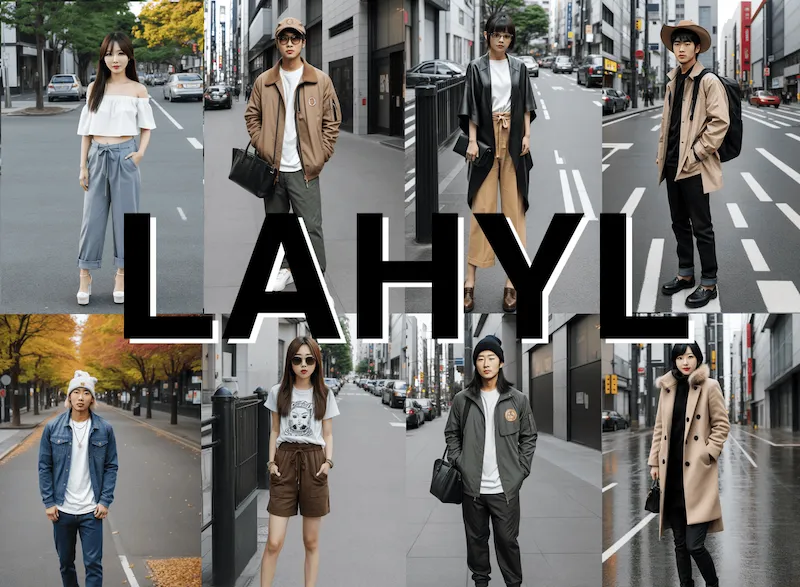
Why I Built LAHYL
— Why someone without a strong fashion obsession is building an AI-powered apparel service
Introduction
I’m not the type of person who’s extremely particular about fashion. Yet I often catch myself spending a lot of time casually browsing fashion websites and apps, street snaps, and social media. Watching people around me, I feel many also spend more time “just looking” than actively choosing.
Despite seeing so much information,
I rarely encounter something that feels like “this is it.”
That small sense of discomfort became the spark for LAHYL.
Why is it hard to feel satisfied despite the abundance of information?
The internet is flooded with fashion-related content.
- E-commerce sites
- Street snaps
- Influencers on social media
- Coordinate-sharing services
Even so, I rarely experienced moments that truly felt aligned with my own sense of style.
If I put it into words, things often felt “too fashionable” or “too far from me.”
A massive market with a surprising gap
Japan’s apparel market alone is said to exceed 8 trillion yen in size. Despite being such a large B2C market, there are surprisingly few services leveraging AI.
Among existing AI fashion services, many focus on:
- Size measurement
- Body-type diagnosis
- Personalized recommendations
— in other words, solutions that “present the right answer.”
But fashion, at its core, may be closer to feeling than to data.
The mismatch with overly active AI fashion experiences
Existing AI fashion services tend to share these traits:
- You can’t start without entering lots of information
- They conclude with “this suits you”
- They demand strong proactiveness from users
But real fashion experiences are more passive.
- You just happened to see an outfit you liked
- You were drawn to a single image that appeared on your feed
- You can’t explain why — you just liked the vibe
Most people don’t look at clothes to analyze them.
They simply keep browsing — and occasionally feel a natural pull.
Street snaps: a refined format
Street snaps come close to this feeling.
They work because:
- They can stand without heavy brand or price information
- Outfits express a person’s identity
- They foster “I like the vibe” more than “I’ll copy this exactly”
There are already many excellent street-snap sites. But as long as humans do the photographing, it naturally centers on the “fashionable.”
As a result,
the world they depict often caters to people with high fashion sensitivity.
A fashion experience for the majority
If the apparel market is this large, then people with strong fashion obsession are likely the minority.
Many people:
- Like fashion, but aren’t experts
- Want to look stylish, but don’t want to try too hard
- Prefer “just right” over “the one correct answer”
Services like WEAR and influencer-driven social media already exist for this majority group. However, I rarely see AI services that empathize with this group’s “feel.”
What LAHYL values
LAHYL does not aim to “judge” fashion.
Not “what suits you or not,”
but creating moments of “I want to wear this” and “I like this vibe.”
With LAHYL, we:
- Do not diagnose
- Do not present a single right answer
- Do not force users to input information
Simply by looking, you encounter styles you feel drawn to.
We want to realize this passive fashion experience with the power of AI.
Challenges visible precisely because it’s a solo project
LAHYL began as a solo project. That allows us to keep the philosophy and direction intact, but also means limited resources for fully leveraging AI.
Even so, this sense of discomfort and the underlying hypothesis feel real and promising.
What’s next for LAHYL
LAHYL is not a service that explains fashion.
- You find yourself looking at it
- You’re drawn to it for reasons you can’t explain
- It influences you in subtle ways
That’s the kind of presence we aim to be.
Precisely because I’m not deeply obsessed with fashion, I want to keep building from a perspective closer to the majority’s sense.